24th May Saturday 2025

I have not posted for a very long time.
Life has been complicated.
I said my next blog post was going to be on preparation, and I still have a lot to say about this. I shall get this posted, but had not felt like updating the blog, nor was I able to as my editor (Dad) ran my webite. I now do and shall find a new editor soon, but want to write about what happened today.
The question: should we be actively pulling the boat under us as we come into the catch?
Various people have asked me recently if they should “actively” pull the boat under them, or passively roll into front-stops, or just rock-over & get the weight on the feet and let the boat come to them…?
I had opinions on this, and coached some people and crews (but not all) to actively pull the boat under them. Some of them went very very fast. I had also discussed this with other coaches, and some scullers who have consistently done well. One coach could show me the data of him adding acceleration on the recovery (by actively pulling the boat under him) vs him not. The verdict seemed to be that actively pulling the boat in the recovery gave you a bit more acceleration in the recovery phase, which increased your average speed, and this makes you faster. However some coaches raise a huge flag of warning. If you delay the catch, pulling the boat under you can add check to the boat (unless it is picked up quickly) and slow you down. What happened today has influenced my take on this.
I would love you to comment on what you think is most-effective, or just works best for you, or the people you coach. How should you describe to those learning what the best thing to do on the recovery is? For those going for ultimate speed, what is best-practice?
While sculling to Mouleydier Bridge for the first time with someone in 2025 (I had been myself earlier in the week), I gave him (J) some things to work on. We did some roll-ups before we set off, and then we started the long paddle upstream.
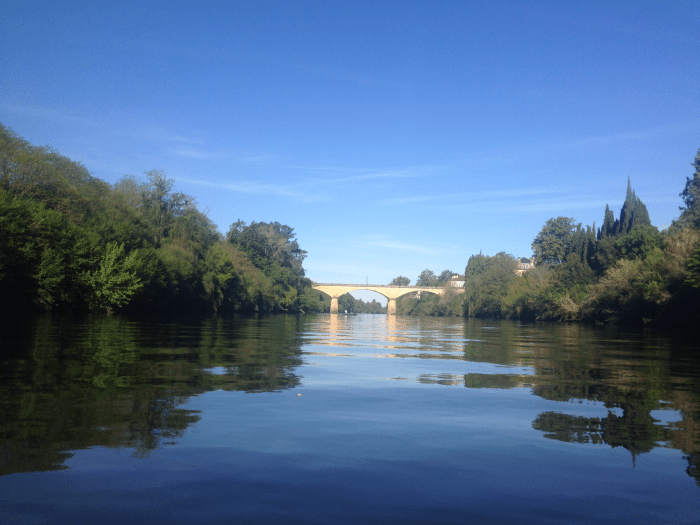
The previous trip upstream I had entered a semi-meditative state just working on breathing and: “connect, push, swing, swing, pull (the boat under me), prepare” repeat. The trip to and from Mouleydier Bridge is a long way (roughly 17km). On that last trip I passed two fishing boats (floating) and no other scullers or rowers. Just me and my sculling… I had been working on breathing and actively working a “push-pull” rhythm, working on changing direction immediately at the front end while holding the shoulders in front of the hips, moving both in and out of the catch with the upper body stable, relaxed, and primed to open against the leg-drive as the hands are about to join… I also became aware of feeling the hands moving with the seat for the intial “hang” at the start of the drive …years of practice and finally getting some lovely flow.
The memory of a recording of a fantastic bit of school eight coxing at the Princess Elizabeth Cup at Henley Royal Regatta, of St. Ignatius College (the then USA school National Champions) against Shrewsbury School (the then British National Schools Champions) kept pinging into my consciousness as I kept trying to return the focus purely to breathing and the “push-pull”, preparation, connection and run… [this recording: a brain worm for scullers/rowers/coxes? If you have not heard it and you like close/good races, listen and let me know what you think]…
Today, once we spun J went off first & I fell straight into the “push-pull”, breathing + the boat (the Tricolour Nelo I raced the British Masters in) started running beautifully.
Push-pull
Push-pull
Push-pull
I was really aware of the boat moving under me as I rocked over & prepared the blades. It felt efficient. I glanced down: 12.51 meters per stroke; heart-rate at 123, perfect… rate 19. I was really pleased with this.
I had been discussing the finish posture with J. The biggest thing for him to work on was not collapsing at the finish…. I had been telling him to really sit up keeping the glutes and abs engaged… and to really focus on just this one thing for the whole outing.
As I paddled towards him, I thought I had better practice what I had been preaching and so suddenly added this focus into my simple: breath -> push – pull which I had basically been doing for about 12km straight, with a slight pause when we stopped for water (mine was actually green tea with freshly crushed ginger put into the hot green tea) and again when we spun. So, I added a fundamental essential: focus on keeping the glutes and abs engaged not just at the finish but at the rock over and coming into the catch. Lots of us think we do this, but engaged, activated and powerful… when this actively engaged core/base is added to everything else…
Push-pull sit up
Glutes Engaged
Abs engaged
And then, suddenly, an image sprang into the fairly empty head: change from pulling the boat to coiling springs up (another image I have used coaching, for many years, but had not used on myself. Now I focused on coiling from an actively engaged base/core); as I approached the catch, the spring coil getting tighter, more coiled/primed/compressed and then, as the blades connected, release the springs, a connected press & then swing against this solid leg-drive + clean extraction, engaged core and I was sitting up on this coiled spring, rocking back onto the sprung but still engaged spring.
Then, from somewhere, the image of a serpent coiled under me … in me … and part of me … legs coiling up + springing back and then swinging back on on an engaged and powerful serpent… and again… both legs coiled serpents compressing, building energy and then leaping open. My base felt stronger and better connected than ever. I glanced down. 13.53 meters per stroke.
WOW
Still at 19 strokes per minute, but my heart rate had gone up to 132 beats having been cruising for about the last half hour to forty minutes at 123.
- The connection was/felt great
- Seat changing direction almost immediately
- Upper body really relaxed
- Shoulders in front of hips for first half of leg-drive
- Opening up against the connected leg-drive as hands come together
- Sitting on top of engaged glutes
- Swinging on top of engaged glutes (with an image of a huge coiled serpent beneath me)
I have been doing yoga now for over 25 years. I have always dismissed people discussing “awakening Kundalini”, as being a touch… shall I say… “out there”…and not where I was, which I felt was grounded, reasonable, rational and not particularly interested in some of the rather esoteric areas linked with yoga. I have only recently been working on meditation (the true purpose of yoga being to prepare the body for meditation … not to awaken Shakti, the female goddess in all of us, nor to awaken the giant serpent of (often depicted as erotic) energy that lies mostly dormant at the base of the spine… these were aspects of yoga that did not interest me.
I had linked the Kundalini with erotic aspects, as this is how it was often promoted by Kundalini yoga classes I had seen advertised. I then by extension, always skipped over any mention of Kundalini in my various yoga texts. I remember bits of what we were taught in lectures on my various yoga courses, but I did not engage with what I thought was some esoteric aspect I would never consider bothering with… I have never been to a Kundalini yoga class, despite trying nearly every other type of yoga and yoga class. And here I was, for a couple of minutes, feeling as if I were sitting up on a huge serpent + my legs had become some coiled serpent springing/leaping back and the power and feeling of increased height at the finish, and support/energy/base below… felt amazing.
I stopped and told J.
Shortly after we started again I tried to replicate the feeling. Sadly, the last few KM home, I was unable to get this same astonishing feeling back.
Perhaps tomorrow.

Perhaps.
One thing is certain… I am going to try to get this feeling again. I shall also find out more about Kundalini. Most importantly: as a mental image, a mental template, for helping with posture, movement and flow, it worked. Sadly only for a couple of minutes. The key was the work earlier on pulling the boat under, almost into and below me, on the recovery and then changing this image to the legs compressing springs into an engaged core. This worked really well.
Compress, don’t pull?
Compression is often used as a concept in karate, to increase power, as a school friend who has a black belt two dan recently told me: “using compression in muscles increases power in movements”. She gave me various examples. It makes sense that compressing the muscles in preperation for the drive would make the drive more powerful. So now, I am going to work not on pulling the boat under me, but pulling and then compressing the springs, coiled energy, in the legs… and the catch: releasing the compressed/coiled spring. Simple. Will this make me faster? We shall see.
So, thoughts on this?
And actively pulling the boat under us on the “recovery”: thoughts on this?
Please comment!
Most people have been holding back on commenting on my blog for some reason… just as I have been holding back on finding out about anything to do with Kundalini …. I shall start reading up on it now… Comments gratefully received. I shall try to post the blog on “preparation” soon.


 Chez Boileau
Ali
Just a quick note to say how much I appreciated this post
Needs a long considered reply but you are miles ahead of the competition when it comes to mind over matter
chris Yours sincerely
Chris rowing@atics.co.uk
LikeLike