Yesterday I was out of the coaching launch and back in my single.
Less than two weeks until I shall be racing it at the World Masters Regatta in Banyoles, Spain. Tomorrow three guests show up and training and tinkering with my boat will be much harder.
I had a basic workout planned:
- Warm up
- Three short bursts
- Six two minutes at race pace with four minutes rest between each
I had achievable targets for both power (288 watts) and rate (36 spm). I hit neither. I had basic targets of splits/speed and catch and finish angles (65 to 42 degrees). I did not hit these targets either.
I was way off. I was too slow. I was weak. My stroke shortened up. I was not sculling well, nor was I sculling quickly enough to win a medal. Only two weeks to go… and I shall have to drive the trailer to Spain, organise lots of things, and all of this will be tiring and distracting. This is a problem. Depressing.
A good friend asked how things were going and I moaned back. I complain about not having any power or strength and that I had just had a terrible outing. She writes back this morning:
“Well, no sympathy on the training results yesterday… your data told you to recover!“
I had forgotten that the day before yesterday (the Japanese have a word for this… well for “the day before yesterday”, not for “forgetting something from the day before yesterday”… that would be useful!) my heart rate variability(HrV see footnote )1 was very short.
This meant I should limit intensity of training. I did. I was told this by an app I use in the mornings to check my heart-rate and HrV. I also had a slightly elevated heart rate. Yesterday my HrV was back to green for training, but HR was still slightly elevated. I forgot that the day before I had been told to “limit intensity”. I just remembered the “green: ok to train” for the day (I also forgot that I had mentioned this to Lorraine, who by the way said that she may well edit this blog post for me … now that my dad is not longer around to do so… Lorraine, sorry this text rambles somewhat!). Here are screenshots from my app showing the heart rate and HrV.
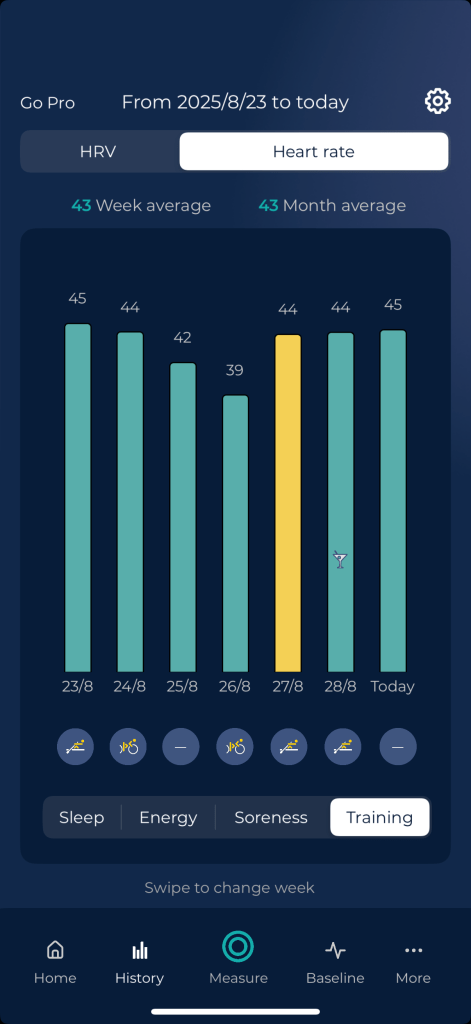
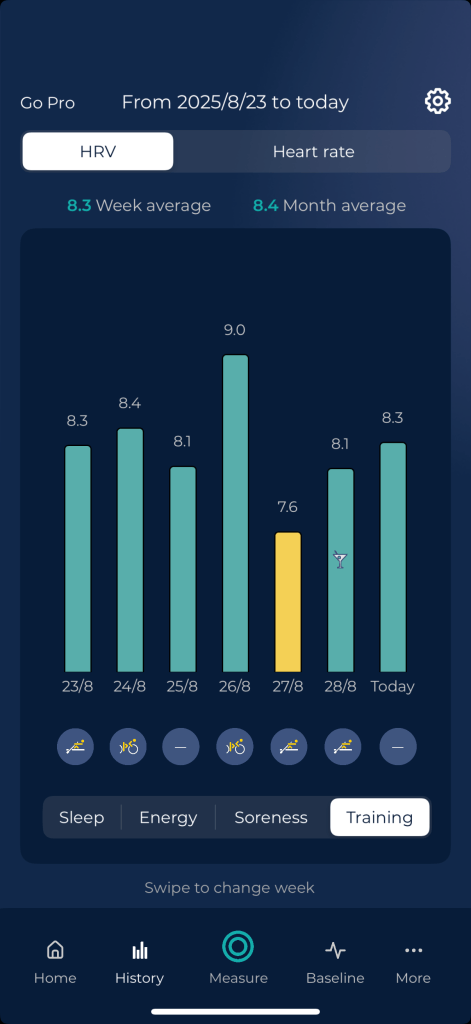
The low HrV often happens if you are about to become ill. If you train hard when you have low HrV you probably will get ill. Paying attention to it really does help to minimise “down-time”. When you have a stressed system … do more stretching or technical work, not a hard session. I have ignored it several times and regretted doing so. Several of the top school rowing programs have been using it now for well over a decade. I use an app called “Heart rate variability for training”, which was just one (of many available apps) recommended by my friend John Hale who is a serious cyclist/sculler and has been helping me plan my training for several years.
So I looked at some other data I had lying around on the ping-pong table:
My body fat measurements from exactly a year ago (well, the 28th of August 2024, today being the 29th of August 2025), and a couple of days in May this year. This comes from an old Tanita set of scales which measures electrical charges through the body and runs it through tables of data and comes up with these figures. It is not hugely accurate, but it does show patterns and changes. I can see that I was a bit dehydrated (I should be around 60% water not 57%) and that the amount of muscle has gone down. So I am actually probably weaker, with two kg less muscle… I mentioned this to mum who correctly said, when I mentioned this when chatting earlier today: “but then you have less to carry and so the boat will have less resistance and so you will need less strength to move the boat just as quickly” … she is right, but … I was focusing on feeling weaker. And the boat moving slower, which it was.
| Date | 28th Aug. ‘24 | 19 May ’25 ** | 26 May ’25 ** | 29 Aug ‘25 |
| Weight: | 76.9kg | 77.8kg | 78.0kg | 75.6kg |
| Bodyfat: | 6.6% | 10.1% | 9.5% | 8.9% |
| Hydration levels: | 59.9% | 56.4% | 58.5% | 57.1% |
| Muscle weight: | 68.2kg | 66.6kg | 67.1kg | 65.5kg |
| “Metabolic age”: | 41 | 41 | 31 | 42 |
| Bone weight: | 3.5kg | 3.5kg | 3.5kg | 3.4kg |
| Visceral fat: | 5 | 6 | 4 | 6 |
[The data from May this year is interesting as I had been experimenting with some fasting, just before this, and my friend Kate (a rower and now nutritionist see https://www.kateslatter.com/ ) was running a sugar-free challenge and so that week I had no sugar (and did a lot of mileage/training and fasted from Sunday to Tuesday as well as then avoided all forms of sugar for the rest of the week) and felt significantly better at the end of the week (& so thank you Kate! And she raced at the Barcelona Olympics and is planning to also be at the World Masters at the lake where she did her first Olympics!)… and when I get back to London I hope to plan a session with her looking at various health related “wellness” issues to discuss with her and then have a plan for]
So what does this data show us? It shows that I have lost muscle mass! I am actually going to be weaker! I have almost 3kg less muscle than I did this time last year. This is huge.
So, what to do?
The problem: feeling/being weaker and unable to hit “competitive ratings” for the 1km race (I need to be able to go at a happy/clean 36 strokes a minutes (& a little bit faster off the start and a little faster in the last 20~15 strokes) for three and a half minutes with a good, well connected and effective stroke, if I hope to get a medal). I was unable to hit these ratings. I tried to. On the fourth piece I went into a large area of river weed and had to steer out of this and so this piece was off the pace due to this, but all of these were well off the pace. For each of the two minutes pieces (with four minutes of rest between each) the ratings were:
| Distance | Split | Rating | Power | Peak ° | Catch ° | Release ° | °Slip | °Wash | |
| 1 | 513 m | 1:56.8 | 34.5 | 272 W | -4.2 | -57.4 | 39.1 | 9.2 | 7.3 |
| 2 | 474 m | 2:06.4 | 30.8 | 239 W | -5.6 | -59.7 | 40.7 | 10.5 | 9.9 |
| 3 | 470 m | 2:07.6 | 33.4 | 251 W | -4.2 | -57.6 | 38.5 | 10.9 | 8.0 |
| 4 | 453 m | 2:12.3 | 29.8 | 232 W | -4.3 | -59.7 | 41.8 | 10.1 | 10.0 |
| 5 | 471 m | 2:07.4 | 34.5 | 267 W | -4.7 | -55.1 | 38.7 | 10.0 | 8.6 |
| 6 | 467 m | 2:08.5 | 32.0 | 258 W | -5.0 | -57.6 | 39.3 | 9.5 | 9.1 |
My power target was 288 watts average for each of the two minute pieces. This should have been easily achievable, given my earlier workouts. The first 30 seconds of the first few, I found this easy, but then I didn’t and the numbers quickly dropped as fatigue set in. In July I had hit a rate limited at 32 two minute block where I hit 281 watts and it was easy. The final minute of that set of pieces I hit 326 Watts for the whole minute. What had I changed since then? I had moved my gates up one cm, and span out by half a cm on each side and reduced my inboard to increase my catch and finish angles. But was this sensible…? I have hugely improved my “Wash” (the degrees the blade moves after I have stopped applying 200n of pressure on the blade and before I take it out of the water) since July, by working on coming out square, and cleaner, but these catch and finish angles are all too short. I have less that two weeks to the races, should I move the settings back? Or make other changes?
Let’s just look at that data from July, when I was feeling really strong and had had some fantastic training in the mornings and afternoons on the bike, and here was doing blocks with two minutes recovery and then ratcheting up the rating and power, but working on keeping the technique and length. This workout worked very well and I had almost no stream (heading upstream, against the stream), tailwind, towards the Eiffle Bridge and hit my best speeds of the last few years in the last minute:
| Dis | Time | Split | Rating | Power | Peak ° | Catch ° | Release ° | °Slip | °Wash | |
| 1 | 1,319 m | 6 min | 2:16.4 | 23.4 | 216 | -4.3 | -65 | 47.5 | 10.0 | 11.7 |
| 2 | 1,096 m | 5 min | 2:16.4 | 26.3 | 234 | -3.5 | -63 | 47.1 | 10.1 | 11.4 |
| 3 | 923 m | 4 min | 2:10.0 | 28.6 | 234 | -3.3 | -61 | 45.4 | 10.4 | 11.2 |
| 4 | 731 m | 3 min | 2:03.0 | 30.5 | 269 | -3.3 | -61 | 45.4 | 9.8 | 10.4 |
| 5 | 519 m | 2 min | 1:55.5 | 31.7 | 281 | -6.9 | -62 | 44.5 | 9.0 | 10.2 |
| 6 | 301 m | 1 min | 1:39.5 | 34.5 | 326 | -8 | -61 | 43.6 | 8.5 | 9.9 |
The catch angles were much better, as I had started at a lower rating and slowly cranked the power and ratings up. The last release angle is ok. The key to the really fast minute might be the postion of peak force. It is much earlier. -8 degrees. And a lot more force. So, get the force on earlier, faster, and harder/greater (while keeping the shoulders in front of the hips and then opening up strongly against a strong leg-dirve… simple? If I can hit those speeds in the race… I can get a medal… it would be very very hard for the average scullers of my age to beat me if I can hit these speeds for even part of the race…
So, I am going to:
- Lower the gates to what they were (drop them by one CM)
- Shorten my blades 1cm from 285.5 to 284.5 (to make it easier)
- Increase inboard by 1cm from 87 to 88 (to make it easier)
- Consider moving pins back in a bit (closer to what they were in July, but not all the way) to get a bit more angle and both catch and finish (then need to move feet back one cm)
- Focus on more rock-over from hips to get more catch angle
- work on pullng boat into catch (this gives me about two degrees more at the catch)
- connect sooner (have seat change direction instantly and get the power on earlier aim for -8 peak power point
- aim for 42 to 44 degree finish, at least over 40!
- aim for catch angle of over 61, ideally 65
- aim for slip below 9 (prepare & connect sooner) and wash around 8 (come out square/cleanly while still connected, remember to finish in front of me & not pull through the body)…
- All sounds achiveble… but perhaps most importantly…
- go to sleep now so I can recover. Up early… three people arriving and lots to tidy up and boats and blades to get ready… and the ping-pong table is a mess and things are piled up in the sink… oh la la… that sinking feeling… off to bed… shall deal with that tomorrow & shall send this off to Lorraine to proof-read, but may well publish… to see what it looks like… and then edit! Good night… Ali
- Heart Rate Variability (HrV) = the gap between heart beats. If you have a pulse of 60 this does not mean your heart is beating exactly once every second. For example, the gap between beats at a heart rate of 60 might be a little less than a second on one beat and a little more on the next… the difference between these gaps is the HrV. Small changes in variability is bad … and means your system is stressed, and your “stressed system” heart is ticking along like a metronome, larger variation and changes in this gap between beats means that everything is relaxed and adjusting as needed and in good condition ↩︎
 Chez Boileau